
Normandy
Between land and sea, Normandy is an ideal destination for a weekend away with your dog. Its varied scenery includes dramatic cliffs, lush countryside, charming half-timbered villages and lively harbours. Many beaches along the Côte d’Albâtre and Côte Fleurie welcome dogs, making the region especially dog-friendly. Iconic sites such as Mont-Saint-Michel round off this wonderful getaway full of discoveries.
We begin our Normandy getaway on the Alabaster Coast of the Pays de Caux, a spectacular stretch of Seine-Maritime coastline along the English Channel.
This coastal route took us to several charming towns: Étretat, Veules-les-Roses, Varengeville-sur-Mer, Dieppe and Le Tréport.
Along the way, the famous white chalk cliffs offer breathtaking views, especially the iconic cliffs of Étretat.
The coast is also dotted with wide pebble beaches, perfect for a breath of fresh air with your dog.
Étretat
The famous cliffs of Étretat are one of our favourite places in Normandy to visit with our dog.
Start by heading to the sea wall and pebble beach. Dogs are not allowed on the beach, but we still broke the rules to take a few photos in front of the Needle.
We recommend visiting outside peak season to avoid the crowds (especially if you want your dog to set paws on the pebbles), and choosing a sunny day to see the sea at its most colourful!
Two walking paths start from the beach:
• The path on the right leads to the Amont cliff. After a few steps and a fairly steep slope, you will reach the little Notre-Dame de la Garde Chapel and some peacefully grazing cows.
• The path on the left leads to the Aval cliff. Follow the golf course for a wonderful view of the Manneporte cliff.
Both paths offer lovely views, so don't forget your camera!
Take a well-earned break at one of the restaurants in Étretat before ending your day with a browse through the souvenir shops and the covered market hall.
Note that dogs may visit the Étretat Gardens only if carried or placed in a bag.


Veules-les-Roses
Listed among France's most beautiful villages, Veules-les-Roses is a charming coastal village known for its peaceful atmosphere and rich heritage.
Admire its elegant early-20th-century villas, traditional thatched cottages, half-timbered houses and, of course, the many roses that brighten its lanes.
A fun fact: until 1897, the village was called Veules-en-Caux before adopting the more poetic name Veules-les-Roses.
During our visit, we also spotted flax drying throughout the village—a nod to this emblematic Norman crop.

You can also discover the Veules, the shortest river in France at just 1,149 metres long. It winds through the village before flowing into the English Channel.
Our dog enjoyed cooling her paws in the crystal-clear water, and we followed the river to the pebble beach, where it meets the sea.


Dieppe
Dieppe makes for a pleasant stroll along its lively harbour, lined with restaurants.
Cross to the seafront to relax on the wide pebble beach. Dogs are allowed all year except from 15 June to 15 September, when they may only be on the beach outside supervised areas.
If you have time, climb the hill near the castle-museum (which does not allow dogs) for a lovely view over Dieppe and the coast.
Two major events are part of Dieppe's calendar:
• The 56th Herring and Scallop Fair, taking place on 14 and 15 November 2026.
• The International Kite Festival, held every two years; the next edition will take place in September 2027.


Between Dieppe harbour and the beach, we were delighted to discover that our dog could visit the Estran, Cité de la Mer with us.
This museum dedicated to the marine world stands out for its extensive exhibits and educational approach.
Informative panels explore a variety of topics, including shipbuilding, the history of fishing in Dieppe,
how the area's cliffs and pebbles were formed, and environmental issues such as the tidal turbine farm off Dieppe.
We highly recommend it if you visit Dieppe: it is genuinely informative, and our dog was warmly welcomed with a bowl of water!


Varengeville-sur-Mer
The Jardin Shamrock in Varengeville-sur-Mer is an exceptional botanical garden specialising in hydrangeas. It is recognised as France's National Hydrangea Collection, with more than 1,500 plants, making it one of the largest collections in the world. If you are interested in botany, this garden is a must. At the entrance, the owner will lend you a guide to help you find your way around; please return it as you leave. Feel free to ask questions—the owner will be happy to share their knowledge.


A few minutes from the Jardin Shamrock, stop by the Jardin d’Auguste, a charming garden shop combining home décor, plants and country-style inspiration. Dogs on leads are welcome, making it a pleasant place to pause. You are sure to find a lovely souvenir to take home, from decorative items and garden supplies to tableware, fine foods and unusual finds.


Offranville
The William Farcy Flower Park in Offranville, opened in June 1993, offers a pleasant walk through 2.5 hectares of greenery. It is part of the peaceful, leafy Colombier leisure park. We enjoyed a quiet visit with our dog. The park features several themed gardens, a birch-lined path, a small pond, a rose garden, and a fine collection of dogwoods and maples.


Other nearby places to visit with your dog (which we have not yet visited) include:
• le jardin des agapanthes
• le jardin du Mesnil et Parc Botanique de Bray
Quiberville
Between Dieppe and Veules-les-Roses, Quiberville is a charming seaside resort with a long beach that is perfect for a stroll with your feet in the sand. We had a wonderful time there with our dog!
Our hotel was ideally located just across from the sea—perfect for a morning walk or a final stroll before bed.
To the left of the beach, beyond the water-sports centre, you can admire the impressive cliffs of the Alabaster Coast.
The beach alternates between pebbles and wide stretches of sand, depending on the tide.
Just across from our accommodation, the Quiberville tourist office (certified Toutourisme) gave us a warm welcome.
We received a small pack with a dog treat, waste bags and a booklet full of ideas for things to do in the area with your four-legged companion!
It was a lovely surprise and a clear sign of how welcome dogs are here!


Le Tréport
Le Tréport is a charming seaside resort on the border between Seine-Maritime and the Bay of the Somme.
It has a beach, a pretty lighthouse and plenty of restaurants.
Dogs on leads are welcome all year, except from 15 June to 15 September, when they are not allowed on the esplanade or on the stretch of beach between the casino access and the entrance opposite Porte Jacques Sorre.
The Le Tréport funicular, in service since 1908, is also well worth a ride and is free to use.
It connects the upper and lower parts of town in less than three minutes.
Dogs are allowed, and at the top you can enjoy a splendid view of the coast.


Just across from Le Tréport, don't miss Mers-les-Bains, known for its beautiful Belle Époque façades.
Read my article about Hauts-de-France to find out more!
Le Mont-Saint-Michel
A UNESCO World Heritage Site, Mont-Saint-Michel is a must-see destination.
Getting there with your dog takes a little effort!
The car park, once at the foot of the Mont, has been moved 3 km from the entrance.
Shuttle buses allow only small dogs carried in a dog carrier. Other dogs must make the journey to the Mont on foot!
The advantage of walking (about 50 minutes), as we did, is that you have time to take some lovely photos of the Mont from a distance.
In fact, everyone we saw walking to the Mont had a dog with them.
The walk is quite pleasant, as the route is flat and pedestrian-only.
Just hope it doesn't rain!
At the entrance, listen out for the cooks at La Mère Poulard beating eggs in rhythm.
You can then sample their famous omelettes at one of the restaurants before continuing your visit along the cobbled streets and steps that wind up to the Benedictine abbey.
Dogs are not allowed inside the abbey.


Côte Fleurie
The Côte Fleurie, between Cabourg and Honfleur, is a string of charming seaside resorts with elegant villas,
sandy beaches and flower-filled gardens.
It is an ideal area to explore with a dog: the promenades along the sea walls and the old quarters of towns such as Trouville,
Deauville and Houlgate are lovely, and many beaches allow dogs outside peak season.
It is a wonderful place to enjoy the sea, typical Norman architecture and a peaceful atmosphere.
A few ideas for things to do:
In Cabourg
• Play on the beach (dogs are allowed all year on the eastern section, Avenue Durand-Morimbaud!),
• Walk in the dunes along the dog-friendly beach,
• Follow the 3.6 km Marcel Proust promenade along the sea wall,
• Visit the market and shops on the pedestrianised town-centre streets.
In Deauville
• Stroll along the beach with its colourful parasols: from Easter to late September, dogs are not allowed on the beach between 10 am and 7 pm; at other times of year, they are allowed all day,
• Admire the Pompeian Baths and the beach cabins on Les Planches,
• Window-shop at the luxury boutiques.
In Dives-sur-Mer
• Visit the charming Guillaume the Conqueror village,
• Walk around the marina,
• Cross the footbridge to Cabourg.
In Villers-sur-Mer
• Watch birds in the marsh nature park,
• Look for fossils at the Vaches Noires cliffs,
• Walk on the beach, where dogs are allowed all year beyond the water-sports centre (near the Vaches Noires cliffs). Dogs are allowed on the rest of the beach from late September to early April.


Caen
Caen is an easy city to explore with your dog.
We began our visit at the Château de Caen, one of the city's must-see sights.
Entry to the medieval castle grounds is free. We explored the different areas before climbing onto the ramparts.
From the top, you can enjoy lovely views over Caen and its main landmarks.
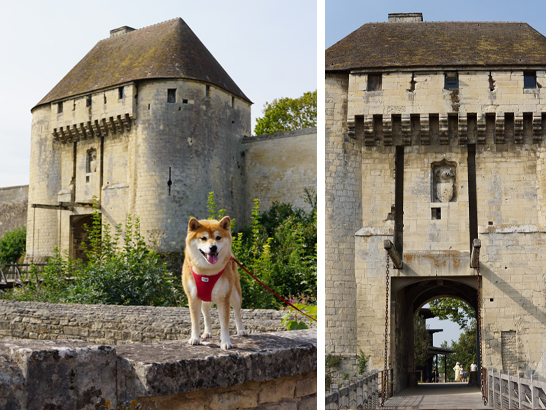
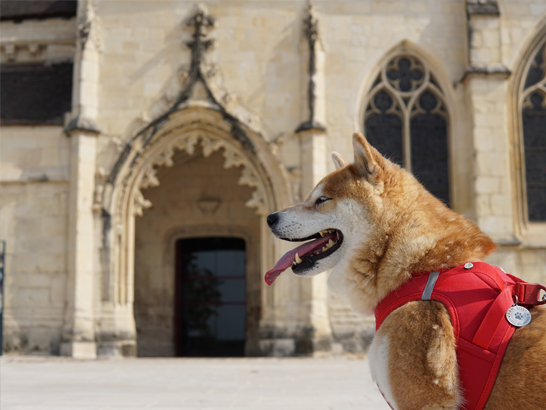

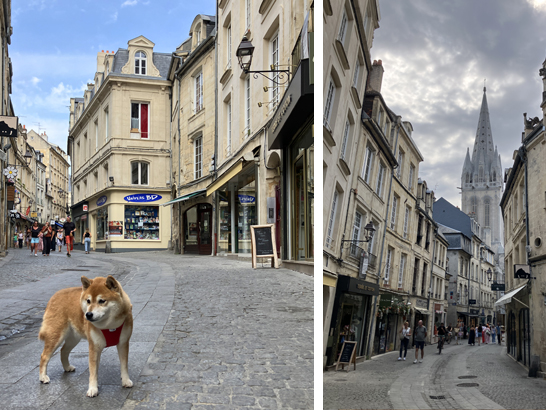
We then explored the historic centre of Caen, which is easy to discover on foot with your dog.
The walk takes you through the old streets and half-timbered houses. Don't miss Rue Froide, one of the oldest and most emblematic streets.
We ended our visit to Caen at Parc Michel d'Ornano, around the Abbaye aux Dames.
It is a pleasant place to walk with your dog, with the abbey cloister as a backdrop.
If you have time, stop by the Caen Botanical Garden, which welcomes dogs.
It is another peaceful place to take a break while exploring the city.
For a longer walk, follow the Orne along the landscaped paths with your dog.
Lisieux
If you pass through Lisieux on your trip, we highly recommend a short stop at the majestic Basilica of Saint Thérèse of Lisieux, whose construction began in 1929.
Although dogs are not allowed inside the basilica, you can take turns visiting to admire its beautiful marble and mosaics in the crypts (admission is free).
While your companion explores this 4,500 m² basilica, you and your dog can wait on the esplanade.
From there, admire the equally impressive exterior, including its 95-metre-high dome.
You can also see the monuments to the right of the basilica with your dog.

Gardens of the Pays d'Auge
About 15 minutes from Lisieux, the Jardins du Pays d'Auge in Cambremer are a real gem!
Dogs on leads are welcome.
When you arrive, you will receive a small guide with a detailed map, information about the different gardens and a suggested route.
This remarkable four-hectare garden is beautiful and immaculately maintained, with plenty of trees and hydrangeas. We particularly enjoyed the dogwoods.
It is divided into themed gardens, including the Moon, Fragrance, Angels and Devil gardens, and every flower bed is a delight!
You can also see several traditional buildings typical of the Norman Pays d'Auge.


Gardens of Château de Canon
This is another remarkable garden we had the pleasure of visiting in Mézidon-Canon with our dog, and we thoroughly enjoyed it!
The grounds around the castle and pond offer a romantic stroll through flower gardens, where workshops are held to make your own bouquet.
Designed in 1768 by Elie de Beaumont, the garden has been preserved in its original form since the 18th century.
As you explore, you can also discover the "chartreuses": ten walled gardens, now beautifully planted, which once protected exceptional fruit crops.
In the evening, we were lucky enough to see the illuminations held on selected summer evenings.


Vernon and Giverny
Located in Vernon, the Château de Bizy was built in 1740 and inspired by Versailles. Dogs are not allowed inside, but are welcome on leads in the magnificent grounds. Enjoy the fountains and remarkable, centuries-old trees. If you visit during a hot summer day, your dog can cool off in one of the many streams.


Before leaving the area, stop on the banks of the Seine to see the Château des Tourelles and the Vieux-Moulin,
a former watermill that is now a symbol of Vernon.


Ten minutes from Vernon, wander through the pretty streets of Giverny, a famous village that is especially beautiful in spring.
Unfortunately, dogs are not allowed in Claude Monet's garden or the gardens of the American Museum.
Abbaye de Mortemer
Set in the Lyons Forest, Mortemer Abbey is famous for its White Lady, a female ghost said to have haunted the ruins since the Middle Ages.
If ghosts don't frighten you, explore the abbey grounds with your dog. You will find a dovecote, a pond and a few ruins.
You can then visit the ghost museum and furnished apartments with your dog on a lead to learn more about the abbey's legends.
Take the opportunity to visit Lyons-la-Forêt, a village just a few kilometres away and considered one of the prettiest in France.


Château-Gaillard - Les Andelys
For a place steeped in history and offering breathtaking views over the bends of the Seine, head to the heights above Les Andelys to discover the majestic ruins of Château-Gaillard.
Built by King Richard the Lionheart in 1198, the fortress has witnessed fascinating historical events over the centuries.
Enjoy a peaceful walk around the fortress grounds with your dog!
The park below Château-Gaillard is freely accessible, with a car park nearby.


Évreux
When you arrive in Évreux, the capital of Eure, start by admiring Notre-Dame Cathedral, built in the 11th century.
Dogs are not allowed inside, but if you are travelling with someone, you can take turns visiting. Behind the cathedral, stroll through the cloister
and continue into the town centre via Place du Miroir d'Eau.
Here are a few ideas for things to do with your dog during the rest of the day:
• stroll through the botanical garden,
• admire the town from the Saint-Michel viewpoint,
• walk along the greenway (join it near the golf course),
• explore the woods at Senghor or Saint-Michel,
• meet the farm animals at the Navarre educational farm.


We particularly enjoy walking in the grounds of the Château de Trangis.
Entry to the estate is free.
It has large lawns perfect for picnics, as well as a wooded area with a treetop adventure course.
If you are interested in botany, don't miss the plant fairs held in the park each year.


Harcourt Castle Arboretum
During Harcourt's autumn plant fair, we had the chance to explore the 19th-century arboretum at Château d'Harcourt with our dog.
This medieval castle, surrounded by a moat and circular towers, has retained much of its original 12th-century structure. (Part of the façade was being renovated during our visit.)
The path to the fair was beautifully decorated with hundreds of pumpkins, and the park was dressed in gorgeous autumn foliage. It was a wonderful experience!
If you enjoy plant fairs, we highly recommend the Automnales, held over the weekend of 19 October 2024!


Rouen
Rouen, the capital of Normandy, is easy to explore on foot with your dog.
Start at Place du Vieux-Marché, where Joan of Arc was burned at the stake in 1431.
Then head to the square in front of Notre-Dame Cathedral and follow Rue du Gros-Horloge, the first pedestrian street in France.
There are plenty of shops, and you can admire the 14th-century astronomical clock.
If you are travelling with someone, take turns visiting the cathedral, built in 1030, before continuing to Rue Damiette, known for its antique shops.
Remember to look up at the half-timbered houses!
For a little greenery, head to Saint-Ouen Abbey Church and the Town Hall gardens, where dogs are allowed on leads.


What to pack for a trip to Normandy with your dog
To make the most of your Normandy holiday with your dog, a few accessories can make walks in nature much easier. Here are some essentials we always take with us.
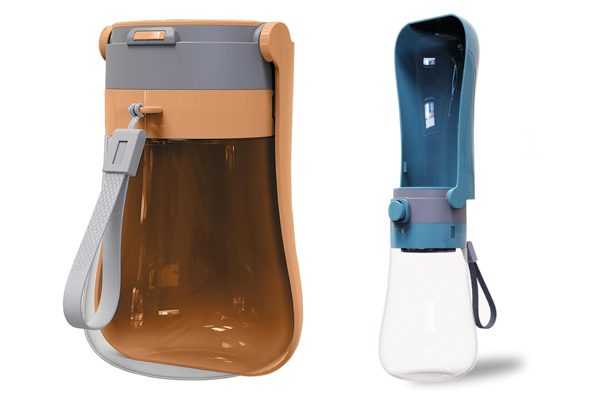
Travel water bottle
Keep your dog hydrated on walks. Practical, leak-proof and always close at hand.
Discover the product
Foldable bowl
Folds in seconds and fits in a bag. Perfect for meal breaks while travelling.
Discover the product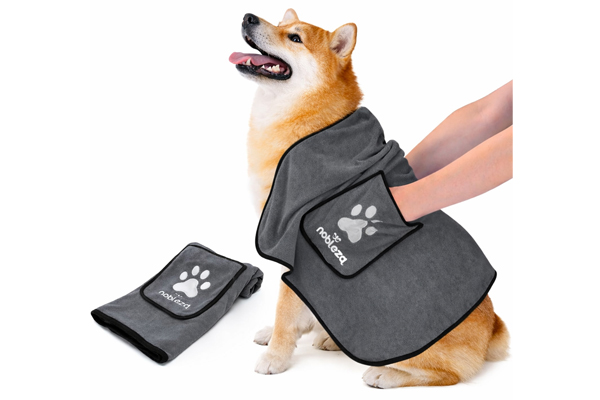
Microfibre towel
Dries your dog in minutes after a day at the beach, in the rain or in the water.
Discover the product
GPS tracker
Track your dog in real time and enjoy peace of mind on your walks (subscription required).
Discover the product Follow us!


